
FROM STING TO STRENGTH: THE NETTLE JOURNEY
HOW DO YOU TRANSFORM A PLANT THAT STINGS INTO A THREAD THAT ENDURES FOR GENERATIONS?
This question brought us to Jiri, a village at 1900 meters, where village women still process nettle as their grandmothers taught them. Accessible only after an eight-hour, 180-kilometer bumpy jeep ride through mountain valleys and rutted paths, we came for transparency - to witness the complete transformation of Girardinia diversifolia, locally known as Allo, from aggressive jungle plant to one of the strongest natural fibers in the world. Allo grows naturally in forests above 1500 meters, developing some of the longest plant fibers known, stiff and resistant in its raw form, nothing like the soft thread it will become. Entering Dolakha district through misty mountains
THE TRANSFORMATION
Mouna appeared the next morning in a traditional dress, her warm presence and broad smile as welcoming as the gold tooth. Together with Kaki, they led us deep into jungle territory where nettle grows wild, navigating dense undergrowth to find the Allo plants at their prime. They showed us which stalks to harvest, how to strip away the stinging outer layer, and how to separate the fibrous bark that holds the material's potential.
 Mouna and Kaki collecting allo/nettle
Back in the village, the real transformation began. The village women who process the harvested nettle carry knowledge passed down through generations, knowing exactly how long it must simmer in water mixed with wood ash, when to begin the beating, and how the fiber should respond at each stage.
After boiling, the fiber emerges nearly black with a muddy consistency. The women work in pairs with wooden tools, beating the cooked material in alternating rhythm until the fibers separate. After washing in large basins, the deep color lightens to brown.


The fibers get coated with clay soil to prevent them from clinging together during drying. Hung under the Himalayan sun, they stiffen. Another beating with boards breaks apart the clay's hold, preparing individual fibers for hand-spinning.


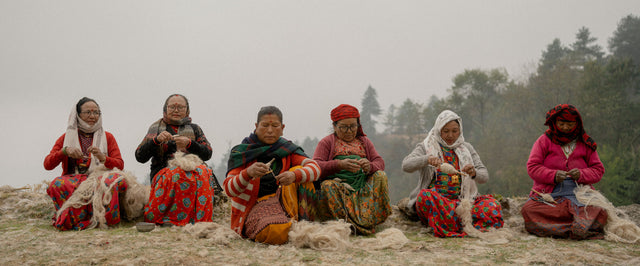
During the spinning, traditional Nepalese songs fill the workspace, songs about love and the journey of life, expressing how hearts blossom like flowers when they encounter their loved ones. These melodies pace the work and connect each movement to cultural heritage passed down alongside the technical knowledge. The visual moments felt cinematic without staging: women silhouetted against a misty Himalayan backdrop, hands moving in rhythmic patterns.


Our days ended with unexpected generosity. Mouna's family welcomed us to share food and stories, offering fresh vegetables from their mountain soil as parting gifts.

WHAT MAKES NETTLE DIFFERENT
The final thread carries a light brown natural color and character distinct from any other fiber. Compared to wool, nettle is significantly stronger, more durable, more elastic, more resistant to daily wear. In high-traffic areas where wool would compress, nettle maintains its structure. It resists sun fading, refuses to felt, and wears down slowly across years rather than months.
 Finished nettle
This is craft as perseverance, the dedication required to transform something fundamentally resistant into something fundamentally useful. Every nettle rug carries mountain soil, monsoon timing, wood ash chemistry, and patient hands. When you walk across it, you're walking across a transformation that can't be rushed or replicated by machine.
How does knowing the full journey change what you feel underfoot? Does understanding that each thread passed through fire, water, clay, and song shift how you value what endures?
The nettle doesn't surrender easily. Perhaps that's why it endures.
All photo's and video's are made by lifestyle photographer and videomaker Santosh and Anish.


