
LO-FI LUXURY: DESIGN AS TRANSLATION
Every Tapín rug begins as something that can't be replicated, intuitive marks on paper, paint that drips and flows without permission, brush bristles that scatter in unexpected directions. This is where design starts: in the art-effects, the human variations we preserve rather than eliminate.
THE ANALOG FOUNDATION
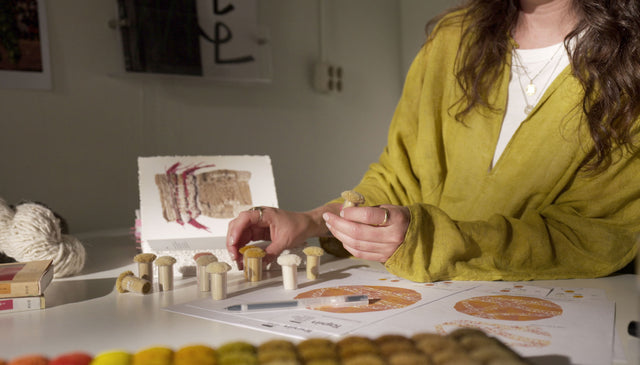
In the Tapín studio, large sheets become playgrounds for intuitive exploration. Paint techniques create texture, materials generate structure, and movements produce form. A paint drip becomes a design element. Bristles shooting in all directions create organic patterns you can't plan. This is what musicians call lo-fi aesthetic: the imperfection that makes something feel alive rather than sterile.
We work this way because nature doesn't design in straight lines. The analog phase captures human hand meeting material in real time.


DIGITAL COMPOSITION
Once analog forms exist, they get digitized and transformed into designs. Shapes find each other. Transparencies layer. Movement becomes dynamic. Forms can overlap, scale, repeat, and interact in ways paper wouldn't allow.
This phase also introduces the technical layer: how color techniques will work, which materials suit which forms, how weaving methods might interpret specific textures.


CAD AS BLUEPRINT
The finished design travels to Kathmandu, where an art translator our production house has worked with for years converts design into weaving blueprint. This CAD drawing becomes extraordinarily detailed, each section mapped to specific knots, colors, pile heights, and densities.
The CAD prints at full rug scale. Weavers trained to read these technical drawings follow them precisely.

HAND-KNOTTED REALITY
Three weavers typically work together for weeks, translating the CAD into knotted reality. Despite technical precision, the process remains entirely by hand: knotting, dyeing, washing, trimming. Hand-dyed yarns vary slightly. Undyed natural fibers carry subtle differences. Human hands create imperceptible variations.
This final translation reintroduces the art-effects we began with. The organic variations return through the nature of handwork itself.

WHY TRANSLATION MATTERS
Skip the analog phase and you lose intuitive imperfection. Skip digital composition and you can't explore complex layering. Skip the CAD and weavers can't execute intricate patterns. Skip the handwork and you lose the subtle humanity and ancient techniques passed down through generations.
What arrives in your space carries intuition, design, technical precision, and handwork, every translation visible as human hands transform thread into form.

How does understanding each translation shift what you value? When you know a design passed through analog intuition, digital refinement, technical mapping, and weeks of hand-knotting, does the object beneath your feet hold a different weight?
Studio photography by Hiep, production photography by Santosh, rug photography by Piet Numan


