Skip to content
CONNECTING THROUGH CRAFT

STORIES FOR DAYS ON YOUR FLOOR

HAND-KNOTTED RUGS CARRY A RICH CULTURAL IDENTITY THAT ENHANCES THEIR UNIQUENESS.

SACRED VALLEYS, TIMELESS CRAFT

Every Tapín rug connects deeply to the artisans who craft it. Handmade in Nepal using the Tibetan knot technique, these rugs carry rich cultural identity that enhances their uniqueness. This ancient technique has been refined and passed down through generations since at least the 4th century AD, when nomadic tribes in Tibet developed these methods deeply rooted in their culture and traditions.

From the sacred highlands of the Mustang region and the forest valleys of Nepal's foothills, to the rich heritage of Nepal's capital city Kathmandu, each place offers its own origin story. Raw materials begin their journey in rural areas, then travel to Kathmandu for production. Each step requires time, expertise, and careful attention to detail, bringing together skills from various artisans to create one-of-a-kind designs.

All rugs are handwoven to order with lead times ranging between 12-16 weeks.

NO MACHINERY, NO ELECTRICITY, ONLY NATURE AND PURE HUMAN ENERGY

MOTHERS, FATHERS, SONS AND DAUGHTERS WHO BRING GENERATIONS OF KNOWLEDGE TO EVERY PIECE.

OUR ARTISANS

Our artisans continue these traditions with reverence and joy. During nettle processing, Nepalese songs fill the workspace - songs about love and the journey of life, expressing how hearts blossom like flowers when they encounter their loved ones, connecting the rhythm of work with cultural heritage. These moments of shared melody preserve not just technique, but the spirit behind the craft.

These are not anonymous workers in workshops - they are mothers and daughters who weave between caring for children, women and husbands who support their families through skilled handwork. Each brings individual expertise developed over years of training, combined with cultural knowledge passed down through their communities.

THE TIBETAN KNOT TECHNIQUE

Hand-knotting is extremely complex and ancient production technique. Made manually on a vertical loom where the thread is strongly attached to the warp using knots. This traditional technique is characterized by being a slow and extremely complex process. Knot by knot, a single rug can have up to 250,000 individual knots per square meter, allowing the creation of highly detailed designs.

Skilled artisans complete approximately 8 centimeters of knotting per day — a pace that reflects both the technique's complexity and the attention each knot demands. This is why it takes 12-16 weeks to produce a hand-knotted rug, depending on quality and size. Hand-knotting creates luxury that is impossible to replicate with machine techniques.

The complete production process is explained in 10 steps below

1. COLLECTING AND PROCESSING RAW MATERIALS

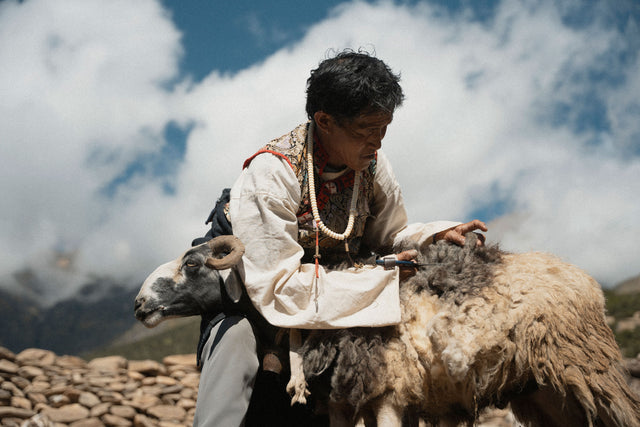
While production takes place in Kathmandu, raw materials come from different rural areas in Nepal and Tibet. In the highlands of the Mustang region and the forest valleys of Nepal's foothills is where every rug story begins. The process of collecting raw materials takes time, expertise, and attention to detail. Careful selection and inspection of raw materials ensures that only the finest components are chosen.

Read the Story about our journey to Nepal's Jiri village to witness nettle's transformation.

Learn more about collecting Himalayan wool in Mustang region in our
conversation with Santosh.

2. CARDING BY HAND

The carding process involves disentangling, cleaning, and intermixing wool fibers to produce a continuous web. Done using a carding machine or hand carders with fine, closely spaced wire teeth. As Himalayan wool passes through the carding machine, it is combed and aligned, transforming into a thin, fluffy layer called "carded web" ready for spinning.

3. ANALOG SPINNING

Raw fibers are then carefully spun into continuous lengths of yarn using a spinning wheel. The experienced spinner uses their fingers to manipulate the material and combine it into robust strands of the correct size for the knot number required.

4. CREATING A REAL SIZE GRAPH

While yarn is being prepared, our pattern designer creates a computer-generated graph from Tapín's original design. This acts as a map for weavers, so they know exactly how to recreate the rug design and what color each knot should have. Traditional meets digital to preserve accuracy while honoring artistic vision.

Fact: our Earth Vibration rugs contain around 89 colors.

Earth Vibration collection

5. DYEING YARNS

Our dye master prepares dye specifically for the production of each rug. The yarns are being fully immersed in the color bath. Materials take color uniformly, depending on fiber, with some materials adhering to dye better than others.

Our dyeing facility operates with a plant-recycling system which is a closed-loop setup designed to recycle wastewater, chemicals, and textile waste. This process allows us to minimize environmental impact while maintaining the highest color quality. Every shade we create is the result of a careful balance between craftsmanship and conscious production.

Learn more about the different materials and their qualities.

6. SUN DRYING

The dyed yarn is allowed to dry naturally in the Himalayan sun. The sun is important for drying process as it gives yarn special luster and nuance to color.

7. HAND-KNOTTING TECHNIQUE

Hand-knotted rug weaving is carried out on a loom. The loom has a wooden frame strung with vertical threads of cotton looped tightly between top and bottom bar to create tension. These threads are called warps, then weft threads are woven through horizontally.

Every individual knot on a hand-knotted rug is woven by hand, row after row, using the Tibetan knot technique. This method involves yarn being knotted around vertical warp threads and a horizontal metal rod, with every new knot being a continuation of the previous one.

Knot by knot, a single rug can have up to 250,000 individual knots per square meter, allowing creation of highly detailed designs. Skilled artisans complete approximately 8 centimeters of knotting per day — a pace that reflects both the technique's complexity and the attention each knot demands.

Hand-knotting creates luxury that is impossible to replicate with machine techniques.

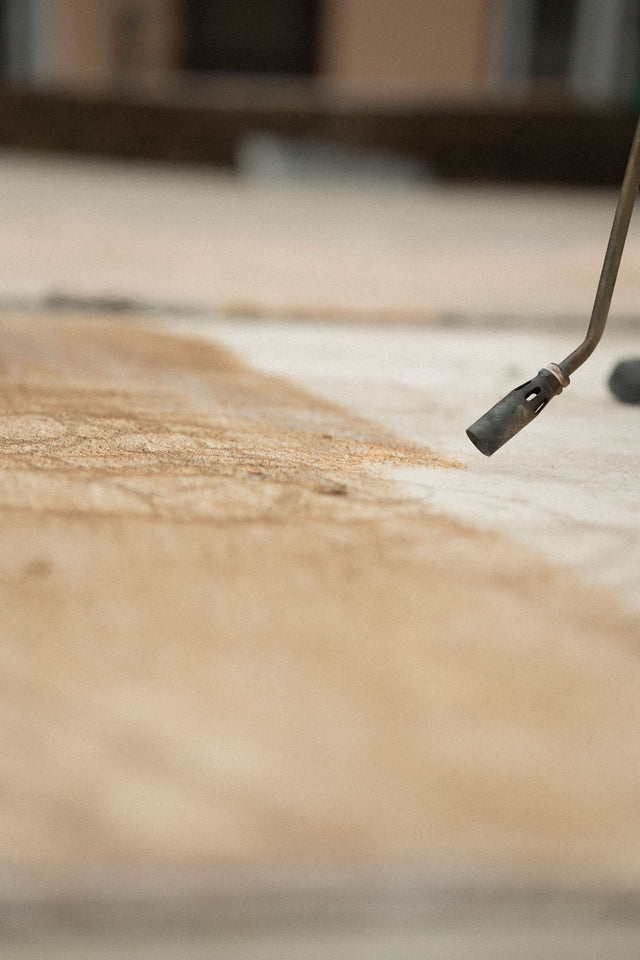
8. SINGEING

Before washing, the surface of the rug is carefully singed with a flame to remove loose fibers and create a smooth, even finish.

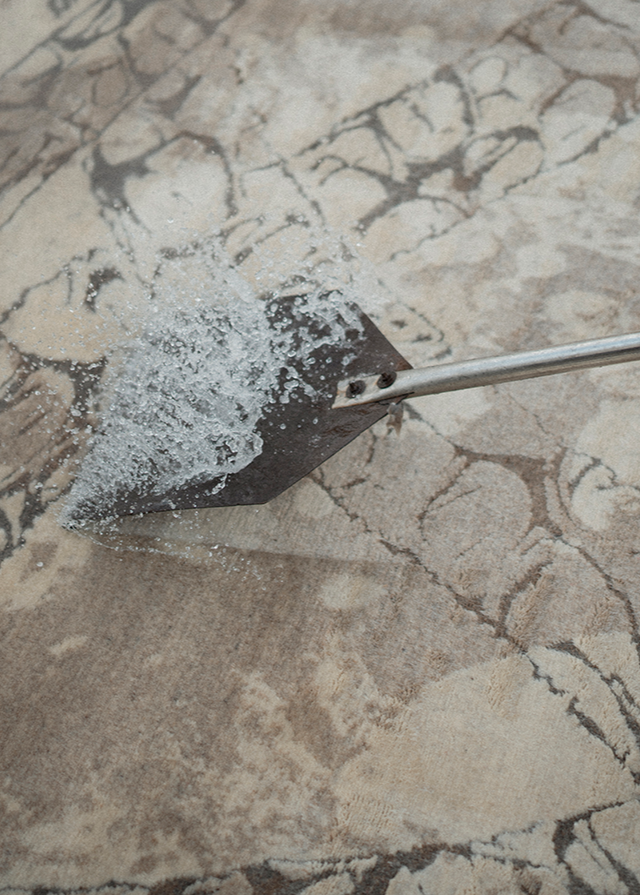
WASHING

The woven rug is cleaned several times on both sides to prepare for finishing. Any dust or dirt that's become knotted in yarn is thoroughly washed out using wooden paddle called 'pharwa' that squeezes water through pile. Washing also helps soften rugs, creating luxurious feel.

STRETCHING

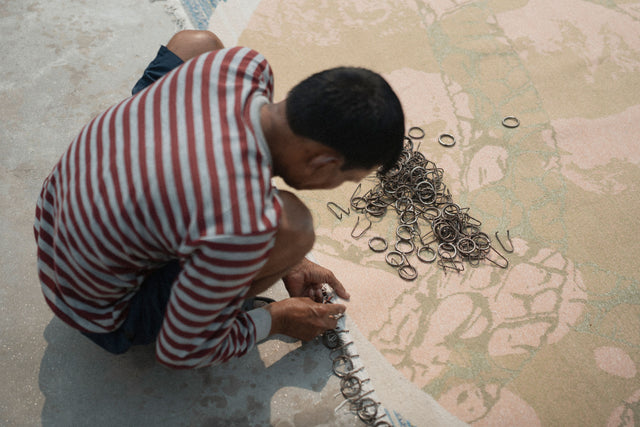
Washed rugs are stretched out to dry in sun and pinned to frame to ensure correct size. Any wrinkles are flattened out and final drying creates deeper and clearer colors.

9. SHEARING AND CLIPPING

After the rug is laid flat, artisans use large flat-bladed shears called 'Kainchi' to even out pile height. They then trim the design details by hand with scissors, refining the different pile heights and removing any uneven threads for a flawless finish.

10. BINDING AND QUALITY CONTROL

The final stage is binding. The edges of the rug are neatly bound by hand using a needle and coordinating yarn that matches the design.

The dense 100k+ knots per square inch create a luxury that is impossible to replicate with man-made fibers or machine techniques. Tapín is committed to creating unique luxurious pieces that last more than a lifetime.

View our rugs